
Powhatan Lodge
1 Pine Island, Newboro, ON
Designated in March 2022 as a property of cultural heritage value and interest by the Township of Rideau Lakes under the Ontario Heritage Act. See attached image and map.
Powhatan Lodge is thought to be one of the oldest buildings on Newboro Lake, constructed around 1904-1907. Search with the Ontario Land Registry on address alone is bringing up nothing, however, judging from the map with the Registry, it appears that this island (shown circled on map) is in Lot 22, Concession 5 in South Crosby, Newboro Lake (originally called Mud Lake).
This is an interesting property, as the registry tells two different early ownership stories. The lot first appears on the registry in 1860, when the Crown grants the land to William Rowswell. It appears to stay in the Rowswell family until 1900 when “20 acres +- with the nearest islands in Newboro Lake” is purchased by George Gifford.
However, this island is also included in Fitzgerald’s Plan #86, drawn up in 1926. Located in the Abstract for Islands in South Crosby in the Ontario Land Registry (accessed Oct. 3, 2023). Denoted as Island #40 (also known as Pine Island), in Newboro Lake, also known as Mud Lake. The Abstract notes that the island was granted to George Gifford by the Crown in 1900, denoted as “Two islands, 16 and 18 acres, opposite lot 22, concession 5”.
Regardless of the island’s original ownership, in both instances George Gifford did acquire the Island in 1900. It quickly became known as one of the Gifford Islands, but starting in 1905 attention was drawn to the incredible Pine trees on the island. At that time it was referred to on the register as being the “S.W. (southwest) Island, 16 acres, reserve of Pine.” In 1905, it seems to have been purchased by George S. Kerr. One year later in 1906 it is purchased by Leroy Latham and A. Wilbur Crane for $100. Some Mechanic Liens put on the property in 1908, suggest there was development around that time. (A mechanic’s lien was a security interest in the title to property for the benefit of those who have supplied labour or materials that improve the property.) This likely means the current house was built in 1907-1908.
In 1917, A. Wilbur Crane and his wife, give Leroy Latham sole ownership of the property for $100. After that, the property is quiet on the registry until 1946, when Charles Latham and his wife, Rita, sell to Paul Leroy Latham and Hugh Leroy Latham for $1,666.65. Interestingly, it is noted on the register that the property exchanged hands, reserving all pine trees.
In 1985, Paul and Hugh Latham sell to John Jr. Torrance, and then Torrance seems to sell to John Michael Kostecky in 1987, but there are no dollar values associated with either of those transactions on the registry. The property is then transferred to Denise Stevens for $210,000 in 1994. Finally, it is purchased by the current owners, George Anderson and Charlotte Gray, in 2000.
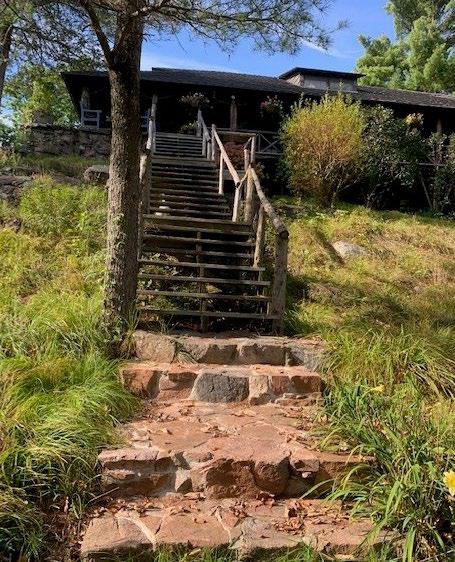
According to the bylaw to designate the lodge, it consists of a two-storey log structure, and stands as a visual reminder of early 1900s on Newboro Lake. The building and site is significant considering its prominent setting on a high rise; interior functional design and symmetrical layout, and its central fireplace and chimney (stone construction). It also includes a wrap-around incised veranda; broad-hipped roof, and interior woodwork including window, doors, unpainted small-pane casements, and tongue and groove quarter-sawn oak ceilings. Solid log construction and mortar was used to reinforce it with rough horizontal courses of granite.
The designation bylaw notes that Powhatan Lodge is a rare and early example of a peristyle bungalow displaying a high degree of craftsmanship. The property has historical/associative value, through its original owner Leroy Latham and with one of its current owners, Charlotte Gray, a prominent Canadian historian.
The designation also draws attention to the property’s contextual value for maintaining and supporting the character of the Rideau Canal World Heritage Site, for being historically linked to other cottage developments in the vicinity, and for its role as a visual heritage landmark along the Canal.
